
Private Jet Charter With Kids: What Families Should Know Before They Book
Private flying can make family travel calmer, but families should confirm documents, child restraints, luggage, pets, catering, medical needs, and quote details before booking.
Why this matters
TimeMake faster private aviation decisions without wading through fluff.
ControlGet clearer frameworks around pricing, timing, routing, and aircraft choice.
Peace of MindReduce friction for business travel, family logistics, and last-minute schedule shifts.
Table of Contents
- 1. The Short Answer
- 2. 1. Documents: Passports, ID, Consent Letters, And Manifests
- 3. 2. Lap Infant, Dedicated Seat, Or Approved Child Restraint?
- 4. 3. Aircraft Size Matters More Than Seat Count
- 5. 4. Luggage, Strollers, Car Seats, And Family Gear
- 6. 5. Catering: Formula, Snacks, Allergies, And Timing
- 7. 6. Medical Needs And Medications
- 8. Start the JetMaster course before you compare private jet options.
- 9. 7. Ear Pain, Naps, And Cabin Comfort
- 10. 8. Pets With Kids: Easier, But Still Paperwork-Heavy
- 11. 9. FBO Arrival: Faster Does Not Mean No Process
- 12. 10. Privacy Is Better, Not Absolute
- 13. 11. Quote Planning: Tell The Broker The Real Family Trip
- 14. Family Charter Checklist
- 15. Questions To Ask Before You Book
- 16. FAQ
- 17. Can you charter a private jet with kids?
- 18. Do kids need passports on private jets?
- 19. Can a baby sit on my lap on a private charter?
- 20. Can I bring a car seat on a private jet?
- 21. Which private jet size is best for a family?
- 22. Can private jets carry strollers and child gear?
- 23. Are pets allowed with children on private jets?
- 24. How early should families arrive at the FBO?
- 25. Source Notes Behind This Guide
- 26. Final Takeaway

Private jet charter with kids can be calmer than airline travel, but only when the family details are handled before the quote is approved. The aircraft still has baggage limits. Children may still need passports or consent documents. Car seats must be aircraft-approved to be used during critical phases of flight. Pets, medicine, catering, and airport timing all need to be disclosed early.
The winning family charter is not the flashiest aircraft. It is the aircraft and operator plan that fits the real family mission.
This guide is written for parents, assistants, and family offices who want fewer surprises before the day of travel.
The Short Answer
Yes, families can charter private jets with children, and the experience can reduce airport stress, improve privacy, and give more control over schedule, catering, luggage, and cabin environment.
JetMaster Executive Briefing
Start The Free Course
Make Your Next Private Flight Decision With More Control
Get the free 10-day JetMaster course built for founders, CEOs, investors, and business owners who value time, cost clarity, family convenience, safety, and smarter private aviation decisions.
But “private” does not mean “no rules.” Families should still confirm:
- Passports, ID, consent letters, and passenger manifest details.
- Whether each child has a dedicated seat.
- Whether the child restraint is approved for aircraft use.
- Aircraft size, lavatory type, and luggage capacity.
- Strollers, car seats, travel cribs, ski bags, pets, and medical needs.
- Catering and allergy requirements.
- FBO arrival time, customs, and security expectations.
- What quote items are included versus extra.
For the bigger planning picture, use JetMaster’s how to rent a private jet guide and private jet charter cost guide.
1. Documents: Passports, ID, Consent Letters, And Manifests
International private jet travel follows immigration logic, not “private means no paperwork” logic. Children may need passports, visas, consent letters, or proof of relationship depending on the route, nationality, and destination.
Operators and brokers also commonly collect passenger details in advance for the manifest. For U.S. private-aircraft international movements, APIS filing is part of the process. That paperwork is usually invisible to the child on travel day, but it still must be handled correctly before departure.
Ask before booking:
- What ID or passport details are needed for each child?
- Does one-parent travel require a notarized consent letter?
- Are there visa, APIS, customs, or entry requirements for this route?
- When must passenger details be final?
Careful wording matters here: do not assume domestic and international requirements are the same, and do not assume private aviation removes immigration rules.

2. Lap Infant, Dedicated Seat, Or Approved Child Restraint?
A lap infant may be legally possible in some operations, but “allowed” is not the same as safest or best planned.
The FAA recommends an approved child restraint system for children under two rather than holding a child on an adult’s lap, because an adult may not be able to hold a child securely during unexpected turbulence. FAA guidance also distinguishes approved child restraints from booster seats, baby carriers, and other devices that are not permitted for taxi, takeoff, and landing unless specifically approved.
The practical JetMaster advice is simple: if you want guaranteed use of a car seat or approved child restraint, specify a dedicated seat at quote stage.
Ask before booking:
- Can this aircraft safely accept the child restraint we plan to use?
- Does the restraint have the correct aircraft-use label?
- Where can it be installed?
- Does each child need a dedicated seat for the plan we want?
3. Aircraft Size Matters More Than Seat Count
A jet may technically seat your group but still be wrong for the family trip.
Families should think beyond passenger count:
- Is the lavatory enclosed and practical for the children?
- Is there enough baggage volume for bags, stroller, car seats, and gear?
- Can anything be accessed in flight?
- Is the cabin suitable for naps?
- Is there enough space for a parent to help a child without disrupting everyone?
- Does the aircraft support the catering or galley needs?
Light jets can be excellent for short trips with simple baggage. Super-midsize and larger aircraft usually offer more cabin, lavatory, and luggage comfort. Heavy and large-cabin aircraft may be better for long-haul, multiple children, extensive bags, or trips where rest matters.
Ask before booking:
- Is this aircraft being recommended for seat count or for the real family payload?
- What is the baggage limit?
- What type of lavatory does it have?
- Is the baggage accessible in flight?

4. Luggage, Strollers, Car Seats, And Family Gear
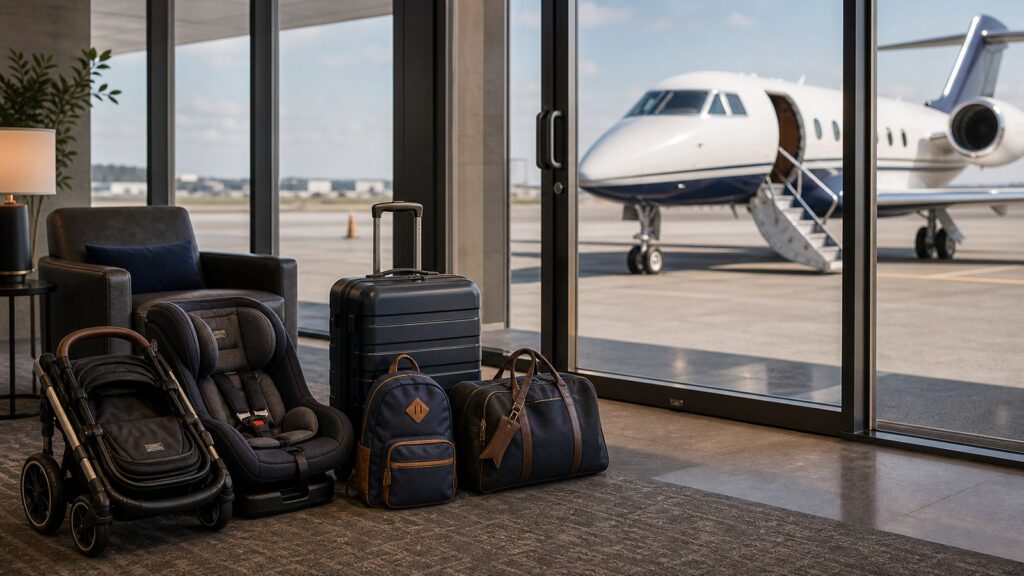
Families often under-specify luggage. A normal adult business trip might involve carry-ons and one garment bag. A family trip can involve checked bags, diaper bags, stroller, car seats, travel crib, ski gear, golf clubs, toys, medication, baby food, and pet supplies.
That can change the aircraft recommendation.
Before quoting, give the broker or operator:
- Number of checked bags.
- Number of carry-ons.
- Stroller type and whether it folds compactly.
- Car seats or approved restraints.
- Travel crib or child gear.
- Sports equipment.
- Pet carrier.
- Any bag or item that must be reachable in flight.
If the provider does not ask for this detail, you should volunteer it.

5. Catering: Formula, Snacks, Allergies, And Timing
Private jet catering can be flexible, but it is not magic if requested too late.
Families should disclose:
- Formula or milk needs.
- Specific brands.
- Allergies and cross-contact concerns.
- Kid-friendly meals or snacks.
- Refrigeration needs.
- Bottle or feeding timing.
- Whether food needs to align with nap schedules.
Smaller cabins may support simpler cold catering, while larger aircraft with better galley capability may allow more options. If allergy control or brand-specific food matters, treat catering as a pre-flight planning item, not a day-of request.
Ask before booking:
- How much notice does catering need?
- Can this aircraft support hot food or only cold service?
- How are allergy requests handled?
- Can milk, formula, or medication be refrigerated?
6. Medical Needs And Medications
Most children can fly comfortably, but families should not improvise medical needs on the ramp.
Disclose early if a child needs:
- EpiPen, inhaler, insulin, injectables, or controlled medication.
- Refrigerated medicine.
- Oxygen or portable oxygen concentrator discussion.
- Medical equipment.
- Recent surgery, illness, premature birth concerns, heart/lung condition, sickle cell disease, or other clinician-sensitive issue.
The CDC notes that children with certain chronic heart, lung, or blood conditions may need extra medical review before air travel. Medications should remain in original labeled containers, and families may need prescription copies or provider notes depending on the trip.
Ask before booking:
- What medical equipment is permitted?
- Can medication be refrigerated?
- What documentation should we carry?
- Should we consult a clinician before this flight?
7. Ear Pain, Naps, And Cabin Comfort
Private flying can reduce stress, but children can still experience ear pressure during climb and descent, motion sensitivity, sleep disruption, and jet lag.
Plan the cabin routine:
- Bottle, nursing, chewing, or swallowing during descent for younger children.
- Snacks and water.
- Nap timing.
- Comfort items.
- Layered clothing.
- Motion-sickness plan if needed.
- Quiet activities that do not require Wi-Fi.
Private aviation gives you more control over environment and timing, but it does not remove basic child travel realities.
8. Pets With Kids: Easier, But Still Paperwork-Heavy
Many private charters are more pet-friendly than airline cabins, but pets can complicate the family plan.
Pet details can affect:
- Aircraft cleaning.
- Cabin layout.
- Pet carrier needs.
- International import rules.
- Vaccination, microchip, health certificate, and CDC/USDA requirements.
- Ground transport.
- Allergy considerations for children or crew.
If you are bringing children and pets together, disclose both early. Do not assume a pet can be added after the aircraft is selected.
Ask before booking:
- Is the pet allowed in cabin on this operator and aircraft?
- What documents are required for the route?
- Does the pet affect cleaning fees or aircraft choice?
- Are there breed, size, or health restrictions?

9. FBO Arrival: Faster Does Not Mean No Process
Families often choose private aviation to avoid crowded terminals, long lines, and rushed boarding. In many domestic situations, arriving around 15-30 minutes before departure may be workable.
But do not treat that as a global promise.
Arrival timing can change with:
- International customs.
- Slot-controlled airports.
- Security program requirements.
- Airport operating hours.
- PPR requirements.
- Complex baggage or pet handling.
- Large aircraft or larger group screening.
Ask before booking:
- What arrival time is realistic for this airport and route?
- Are customs or security steps required?
- Where should the family go at the FBO?
- Can ground transport meet aircraft-side or FBO-side?
10. Privacy Is Better, Not Absolute
Private terminals and charter aircraft can reduce exposure compared with commercial airports. Families may avoid crowded check-in areas and public boarding groups. But privacy is not the same as invisibility.
Passengers still appear on manifests. Operators, FBO staff, crews, customs officials, and security personnel may interact with the family. Screening and security requirements can vary depending on the operator, aircraft, and route.
The trust-first answer is: private aviation can improve discretion and control, but serious providers should not promise that rules disappear.
11. Quote Planning: Tell The Broker The Real Family Trip
The most expensive family charter mistakes often happen before the quote is approved.
Do not quote a family trip as if it were six adults with carry-ons.
Give the real plan:
- Passenger ages.
- Dedicated child seats needed.
- Car seat or restraint type.
- Luggage count and dimensions.
- Stroller and gear.
- Pets.
- Catering and allergies.
- Medical or refrigeration needs.
- Desired nap or departure timing.
- Ground transport requirements.
- Passport, consent, and customs needs.
- Flexibility on airport and departure time.
If a quote changes later because these details were added late, the issue may not be the provider. The issue may be that the first quote was missing the real mission.
For quote mechanics, read Why Did My Private Jet Charter Quote Change? 11 Reasons The Price Can Move after approval.
Family Charter Checklist
Before approving a private jet charter with kids, confirm:
- Each child’s ID, passport, visa, and consent documents.
- Passenger manifest details and timing.
- Whether each child has a dedicated seat.
- Whether any child restraint is approved and can be installed.
- Aircraft lavatory type.
- Baggage capacity and in-flight baggage access.
- Stroller, car seat, crib, pet, and sports-equipment handling.
- Catering, formula, allergies, and refrigeration.
- Medication, medical equipment, or clinician concerns.
- FBO arrival time and airport process.
- International customs, APIS, or entry requirements.
- Quote inclusions and exclusions.
Questions To Ask Before You Book
- What documents do you need for each child?
- Does one-parent travel require a consent letter for this route?
- Can we use our child restraint on this aircraft?
- Is the aircraft chosen for real family gear or only seat count?
- What is the baggage capacity?
- Is the lavatory enclosed and practical for children?
- Can we bring formula, milk, baby food, and medications?
- How are allergies handled?
- Can pets travel in cabin?
- What arrival time should we plan at the FBO?
- What extra fees could appear because of family gear, catering, pets, or schedule changes?
- Who is the direct air carrier in operational control?
For operator-vetting, use JetMaster’s private jet charter safety guide.
FAQ
Can you charter a private jet with kids?
Yes. Families can charter private jets with children, and the experience can be calmer than commercial travel. The key is to confirm documents, seating, child restraints, luggage, catering, pets, and medical needs before approving the quote.
Do kids need passports on private jets?
For international travel, children generally need the required passport and entry documents for the route and nationality involved. Operators may also need advance ID data for manifests. Confirm requirements before booking.
Can a baby sit on my lap on a private charter?
It may be legally possible in some situations, but FAA guidance says the safest place for a child under two is an approved child restraint system, not an adult’s lap. If you want guaranteed use of a restraint, specify a dedicated seat at quote stage.
Can I bring a car seat on a private jet?
Often yes, if it is approved for aircraft use and can be installed safely in the aircraft seat. Booster seats, baby carriers, and some travel devices may not be permitted during taxi, takeoff, and landing unless specifically approved.
Which private jet size is best for a family?
It depends on route, passengers, baggage, strollers, child seats, lavatory needs, and whether naps or long-haul comfort matter. A light jet may work for a short simple trip, while larger cabins can be better for families with more gear or longer flights.
Can private jets carry strollers and child gear?
Often yes, but capacity depends on the aircraft. Give the broker the exact gear list before aircraft selection.
Are pets allowed with children on private jets?
Many private charters can accommodate pets, but route, operator, aircraft, cleaning, health paperwork, microchip, vaccine, and import rules still matter. Confirm early.
How early should families arrive at the FBO?
Many domestic private departures may allow a shorter arrival window, often around 15-30 minutes. International flights, customs, security, busy airports, large groups, or special handling can require more time.
Source Notes Behind This Guide
This guide was built from a source-backed review of operator pages, family-travel search results, FAA child-restraint guidance, U.S. Department of State minor-travel guidance, CBP APIS requirements, CDC travel-health guidance for infants and children, CDC/USDA pet-travel rules, EASA/aviation restraint guidance, NBAA broker/security guidance, and JetMaster’s existing family, safety, cost, and quote articles.
The search results already explain the lifestyle benefits of flying private with children: calmer terminals, flexible catering, more privacy, and easier stroller or luggage handling. The weaker area is the practical booking manual: which documents matter, which restraints are actually approved, how family gear affects aircraft fit, what medical needs must be disclosed, how pets complicate paperwork, and which quote items families should confirm before paying.
Careful wording rules used in this article:
- Do not say private jets are automatically safer for kids. Say they can give families more control when the operator, aircraft, restraints, and documents are handled correctly.
- Do not say there is no security. Say screening is usually more discreet, but requirements vary.
- Do not say every private jet can carry all family gear. Say aircraft fit depends on baggage volume, payload, storage, and route.
- Do not promise a five- or ten-minute arrival. Say many domestic flights may allow shorter arrival windows, but customs, slots, airport hours, and special handling can require more time.
- Do not say pets are easy. Say pets are often more feasible on private charter, but route-specific health and import paperwork still matters.
Final Takeaway
Private jet charter with kids can be a powerful way to reduce friction, protect privacy, and keep a family trip on schedule. But the best experience comes from telling the provider the whole truth before the quote: ages, documents, restraints, bags, stroller, pets, catering, medical needs, and timing.
JetMaster’s recommendation is simple: choose the aircraft for the real family mission, not the brochure seat count.
When you are ready to plan the cost side, use the JetMaster charter cost calculator and request options with the family details already included.