
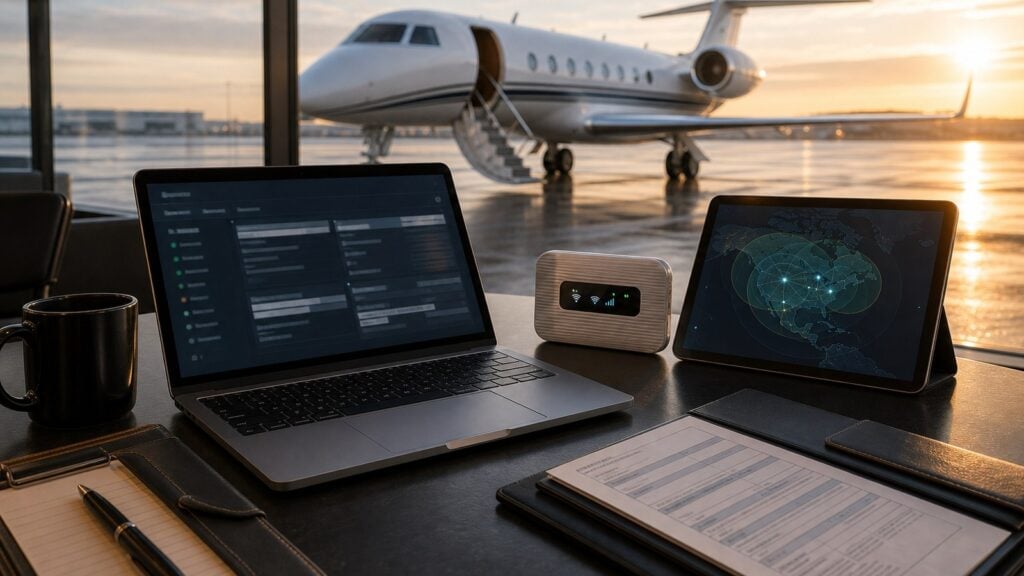
Private Jet Wi-Fi: What Executives Should Confirm Before They Count on Working in the Air
Private jet Wi-Fi is not always guaranteed. Executives should confirm connectivity, coverage, speed, billing, aircraft substitution, and offline backup before flight.
Why this matters
TimeMake faster private aviation decisions without wading through fluff.
ControlGet clearer frameworks around pricing, timing, routing, and aircraft choice.
Peace of MindReduce friction for business travel, family logistics, and last-minute schedule shifts.
Table of Contents
- 1. Private Jet Wi-Fi: What Executives Should Confirm Before They Count on Working in the Air
- 2. Quick answer: what should executives confirm about private jet Wi-Fi?
- 3. Private jet Wi-Fi is not one thing
- 4. “Wi-Fi available” is not enough
- 5. State the work requirement before asking about the amenity
- 6. Cost clarity matters: included, limited, pass-through, or separate
- 7. Route, region, aircraft age, and equipment can all change the answer
- 8. Aircraft substitution can quietly break the productivity assumption
- 9. Privacy and sensitive work: be practical, not theatrical
- 10. The contrarian truth: some flights should be planned as offline time
- 11. What executive assistants and family offices should put in the request
- 12. Red flags in private jet Wi-Fi conversations
- 13. Buyer checklist: private jet Wi-Fi questions to ask before quote approval
- 14. Aircraft-specific availability
- 15. Route and coverage
- 16. Work requirement
- 17. Cost and quote clarity
- 18. Substitution and failure planning
- 19. FAQ: private jet Wi-Fi
- 20. Do private jets have Wi-Fi?
- 21. Is private jet Wi-Fi included in the charter quote?
- 22. Can executives take video calls on a private jet?
- 23. What happens to Wi-Fi if the aircraft is substituted?
- 24. Should travelers prepare for offline work even when Wi-Fi is expected?
- 25. Final thought: protect the working flight, not just the cabin image
Private Jet Wi-Fi: What Executives Should Confirm Before They Count on Working in the Air

Private jet Wi-Fi is usually sold like a comfort feature.
That framing is too soft.
For many executives, founders, investors, family offices, and senior assistants, in-flight connectivity is not a nice cabin extra. It is part of the business case for flying private. The trip may be justified because the traveler can leave later, arrive closer, hold a sensitive call, review documents, coordinate with a team, stay reachable for family, and avoid losing a productive work block inside a commercial airport system.
If that is the expectation, “Wi-Fi available” is not a complete answer.
JetMaster Executive Briefing
Start The Free Course
Make Your Next Private Flight Decision With More Control
Get the free 10-day JetMaster course built for founders, CEOs, investors, and business owners who value time, cost clarity, family convenience, safety, and smarter private aviation decisions.
JetMaster’s position is direct: private jet Wi-Fi should be treated as a mission requirement when the traveler plans to work in the air. A buyer does not need to become a satellite-connectivity engineer. But a buyer should know what is installed on the proposed aircraft, what the provider means by Wi-Fi, whether it is included or separately charged, whether the route and region are realistic for the intended use, how many devices matter, what performance limitations are normal, and what happens if the aircraft changes before departure.
A polished quote can show the aircraft category, route, departure time, passenger count, catering note, and total price while leaving connectivity dangerously vague. If the principal expects a board call, file access, messaging, or confidential work during the flight, that vagueness can turn a premium cabin into a silent office with no usable connection.
This article does not provide technical, cybersecurity, telecommunications, operational, operator-selection, aircraft-maintenance, or network-performance advice. JetMaster does not operate aircraft, install or verify Wi-Fi systems, certify providers, guarantee bandwidth, guarantee coverage, control satellite networks, validate aircraft equipment, or guarantee that any flight will support a particular application. This is a buyer-protection framework for asking better questions before approving a private jet quote.
For broader planning context, pair this guide with JetMaster’s articles on private jet aircraft fit, private jet cabin size, private jet aircraft substitution, private jet quote assumptions, private jet route cost, private jet charter cost transparency, and private jet airport choice.
Quick answer: what should executives confirm about private jet Wi-Fi?
Before approving a private jet quote, executives should confirm whether Wi-Fi is installed on the specific aircraft, whether it is expected to work on the planned route, whether it is included or billed separately, whether there are data limits or fair-use expectations, how many devices can connect, what types of work are realistic, what the outage or weak-signal plan is, and whether a substitute aircraft must preserve the same connectivity assumption.
At minimum, ask for written clarity on these points:
- Is Wi-Fi installed on the specific aircraft being quoted, not just commonly available in the aircraft category?
- Is the service expected to cover the intended route, region, altitude profile, and trip length?
- Is Wi-Fi included in the quoted price, limited, estimated, pass-through, or charged separately?
- Are there device limits, data limits, fair-use rules, activation fees, or usage-based charges?
- What work should the traveler reasonably expect: email, messaging, file access, web browsing, voice calls, video calls, streaming, VPN use, or large file transfers?
- Does the provider avoid guaranteeing speeds, call quality, or uninterrupted service?
- What happens if the connection is unavailable, weak, or interrupted in flight?
- If the aircraft is substituted, will the replacement aircraft have the same connectivity expectation?
- Who should the assistant contact before departure if connectivity is mission-critical?
The practical rule is simple: do not approve a working flight based on amenity language.
Private jet Wi-Fi is not one thing

The phrase “private jet Wi-Fi” can hide several different realities.
On one aircraft, Wi-Fi may support basic messaging and email. On another, it may be strong enough for heavier business use in favorable conditions. On another, it may be installed but not included in the quote. On another, it may be available only in certain regions, subject to data caps, dependent on a subscription, limited by the aircraft equipment, or vulnerable to normal interruptions. Some aircraft may offer no usable internet at all for a particular mission.
The buyer-facing mistake is assuming that Wi-Fi is like the Wi-Fi in a hotel suite or office conference room. It is not. It depends on aircraft equipment, service provider, antenna/system capability, plan terms, route, region, altitude, weather and network conditions, passenger behavior, device count, application type, and sometimes the provider’s billing structure.
That does not mean private jet Wi-Fi is unreliable by default. It means it should be specified instead of romanticized.
The question is not, “Does the jet have internet?”
The better question is, “What exact connectivity assumption is built into this quote, for this aircraft, on this route, for the kind of work I intend to do?”
That question changes the conversation. It moves the buyer away from a generic amenity list and toward mission fit.
A serious traveler may not care whether the cabin has a fashionable interior detail. He may care very much whether he can send an investor update, approve a document, reach his family, join a confidential audio call, keep a messaging thread open, or download a file before landing. The aircraft can look perfect in photos and still fail the productivity requirement if connectivity is vague.
“Wi-Fi available” is not enough
“Wi-Fi available” is one of the most under-specified phrases in private aviation.
Available can mean installed. It can mean expected to work. It can mean available at an extra charge. It can mean available if the subscription is active. It can mean available in some regions but not others. It can mean basic connectivity rather than board-call readiness. It can mean “listed as an amenity” because the aircraft usually has a system, not because anyone has discussed the traveler’s actual work requirement.
None of those interpretations is automatically dishonest. The problem is that the buyer may hear one thing while the provider means another.
Before approval, ask the provider to convert “Wi-Fi available” into plain-language assumptions:
- Which aircraft is this based on?
- What Wi-Fi or connectivity system is installed, if that information is available to the buyer?
- Is the service expected to be active for this flight?
- Is the route inside the expected coverage area?
- Is the quoted price assuming included Wi-Fi, separate billing, or usage reconciliation after the trip?
- Is the traveler’s intended use realistic?
- Are there known limitations for video calls, streaming, VPN, large files, or multiple devices?
- If the aircraft changes, will the Wi-Fi assumption be reconfirmed?
This is not a request for a technical guarantee. It is a request for alignment.
A good provider conversation should make the limitation visible without overpromising. A weak conversation hides behind comfort language: “You should be fine,” “It has Wi-Fi,” “Most clients can work,” or “Do not worry about it.”
Serious buyers should be careful with phrases that sound precise but are not tied to the mission.
State the work requirement before asking about the amenity

The best way to clarify private jet Wi-Fi is to describe the actual work requirement.
Many buyers ask a broad question: “Does the aircraft have Wi-Fi?”
A better request sounds like this:
“During this two-hour flight, the principal needs email, encrypted messaging, document review, and one 30-minute audio call. Video would be useful but is not critical. Please confirm whether the proposed aircraft and route are expected to support that level of connectivity, whether usage is included, and what limitations we should plan around.”
Or:
“The traveler needs to stay reachable for family and office messaging but does not need video, streaming, or large-file transfers. Please confirm the aircraft-specific Wi-Fi assumption and any charges.”
Or:
“We are considering this aircraft partly because the flight time is meant to be a work block. If the aircraft is substituted, connectivity must be reconfirmed before approval.”
That language helps the provider answer the real question. It also protects the buyer from paying for an aircraft decision based on an expectation no one formally stated.
Different work types have different tolerance for weak connectivity:
- Email and messaging may require less performance than video calls.
- Document review may work if files are synced before departure but fail if large files must be downloaded in the air.
- Voice calls may be more realistic than video calls depending on the aircraft and service conditions.
- VPN use may work in some situations and become frustrating in others.
- Streaming can create different expectations than basic business communication.
- Multiple passengers on multiple devices can reduce the practical experience.
The executive’s assistant should not ask for a miracle. The assistant should ask for the likely fit between aircraft, route, system, user count, application type, and billing structure.
That is what private aviation planning should do: translate the traveler’s real-world requirement into a decision-quality assumption.
Cost clarity matters: included, limited, pass-through, or separate
Private jet Wi-Fi cost can be simple or surprisingly unclear.
Some quotes may include connectivity. Some may include basic usage but treat heavy usage differently. Some may pass through charges. Some may bill usage after the trip. Some may require activation or service fees. Some may estimate connectivity costs. Some may include Wi-Fi in the aircraft description while leaving the billing treatment in separate terms.
The buyer-protection point is not that one pricing structure is always better. The point is that the structure should be clear before approval.
Ask:
- Is Wi-Fi included in the quoted amount?
- If included, is it unlimited, limited, fair-use, or subject to restrictions?
- If usage is billed separately, how is it measured and reported?
- Are there activation, access, subscription, or pass-through charges?
- Is heavy usage, streaming, video calling, or large data transfer treated differently?
- Could the final invoice include connectivity charges not visible in the original total?
- Are Wi-Fi costs affected by aircraft substitution?
- Will supporting detail be provided if charges are reconciled after the trip?
The lower quote is not always the better quote if a productivity requirement is hidden outside the visible total. A quote with a clear Wi-Fi line item can look less elegant but be more honest. A quote that says “Wi-Fi included” without defining the practical boundary may invite a later misunderstanding.
The smart buyer does not demand fake certainty where usage can vary. He asks for categorization: included, limited, estimated, excluded, pass-through, usage-based, aircraft-dependent, or subject to reconfirmation.
That language makes the comparison cleaner.
Route, region, aircraft age, and equipment can all change the answer
nn
Private jet internet is not independent from the mission.
A domestic two-hour flight in a well-covered region may create a different expectation than a remote route, oceanic segment, mountainous corridor, international itinerary, high-latitude routing, or multi-leg trip with aircraft changes. An aircraft with newer equipment may create a different buyer expectation than an older aircraft with basic capability. A cabin photo tells the buyer almost nothing about the actual connectivity architecture.
Before approving the quote, ask whether the connectivity assumption is route-specific.
Useful questions include:
- Is the expected Wi-Fi performance based on this exact route or on a general aircraft amenity list?
- Are any portions of the route more likely to have weak or interrupted service?
- Does international routing affect coverage, availability, or billing?
- Does the aircraft’s connectivity equipment support the intended use?
- Are there known limitations with this aircraft or system?
- Is the service plan active and expected to be available for the trip date?
- Does the provider recommend pre-loading documents before departure even if Wi-Fi is expected?
That last question is practical. Even when Wi-Fi is expected, serious travelers should plan important documents and presentations as if they may need offline access. That is not pessimism. It is executive travel discipline.
The goal is not to turn the buyer into a technician. The goal is to avoid approving a productivity-dependent flight with no written understanding of the connectivity environment.
Aircraft substitution can quietly break the productivity assumption
Aircraft substitution is a major reason private jet Wi-Fi should be written into the mission assumptions.
A quote may be approved partly because the proposed aircraft has the right cabin, luggage capacity, range, schedule fit, and connectivity. If that aircraft changes, the replacement may still be acceptable in category, seating, range, or price — but not in connectivity.
That matters if the trip was built around working in the air.
Ask before approval:
- If the aircraft is substituted, will Wi-Fi be reconfirmed before the traveler accepts the replacement?
- Must the replacement aircraft have comparable connectivity for this mission?
- If comparable connectivity is not available, what are the options?
- Would a different aircraft, different departure time, different route, or different expectation be required?
- Will the provider tell the assistant immediately if the replacement aircraft changes the Wi-Fi assumption?
This is where many private aviation conversations become too casual. A provider may say a replacement aircraft is “similar” because it fits passengers and route. But “similar” is not enough if the original aircraft was chosen for in-flight productivity.
A serious buyer should separate cabin equivalence from mission equivalence.
Cabin equivalence asks: does it seat the passengers and complete the route?
Mission equivalence asks: does it preserve the working, privacy, comfort, baggage, timing, and connectivity assumptions that caused the buyer to approve the trip?
For productivity-heavy travel, Wi-Fi belongs in the mission-equivalence conversation.
Privacy and sensitive work: be practical, not theatrical
Private travelers often assume the private cabin automatically creates a secure work environment.
That assumption should be handled carefully.
A private aircraft can offer privacy advantages compared with a commercial cabin or public lounge. Fewer people, more control over who is present, and a quieter environment can make sensitive conversations easier. But that does not mean every network, device, app, document, or call becomes secure by default.
JetMaster will not make cybersecurity promises. A buyer who has legal, financial, defense, health, public-company, family-office, M&A, or sensitive personal work should rely on his own technology, legal, security, and compliance advisors for formal standards.
The buyer-protection question for a private jet quote is more basic:
- Will the traveler need to conduct sensitive work during the flight?
- Does the traveler’s own team permit that work over in-flight internet?
- Should documents be downloaded before departure?
- Should video calls be avoided if connectivity is uncertain?
- Should confidential calls be scheduled for before departure or after landing instead?
- Should assistants avoid planning critical approvals during segments where Wi-Fi may be weak?
This is not fear marketing. It is sober planning.
The strongest private aviation experience does not pretend the cabin is magic. It aligns the aircraft, route, connectivity, passenger behavior, and work expectations with the traveler’s risk tolerance.
The contrarian truth: some flights should be planned as offline time

Not every private jet flight needs to be a flying office.
That may sound strange in an article about private jet Wi-Fi, but it is one of the most useful planning decisions a buyer can make.
If the flight is short, the passenger is with family, the schedule is already compressed, the work is sensitive, the route is remote, or the aircraft’s connectivity is uncertain, the more controlled plan may be to treat the flight as offline time. Review downloaded documents. Think. Rest. Hold calls before departure. Send the final instructions after landing. Use the cabin for privacy and mental recovery rather than forcing a fragile online schedule into the air.
Private aviation is valuable because it gives the traveler more control. Sometimes that control means staying connected. Sometimes it means refusing to make connectivity the weak link in an otherwise calm itinerary.
The buyer’s mistake is not choosing offline time. The mistake is assuming online time and discovering the opposite at altitude.
If the flight must be productive online, specify the requirement before approval. If it does not need to be online, plan the work block honestly and avoid overpaying for an assumption that does not matter.
That is the JetMaster view: private aviation should protect the mission, not decorate the cabin with unchecked amenities.
What executive assistants and family offices should put in the request
Executive assistants and family offices can prevent most Wi-Fi misunderstandings by making connectivity part of the request before quotes are compared.
Do not write only:
“Need Wi-Fi.”
Write something closer to:
“Connectivity requirement: principal needs email, messaging, document review, and one audio call during the flight. Video call support is preferred but not essential. Please confirm aircraft-specific Wi-Fi availability, expected route coverage, included vs separate charges, device limits, known limitations, and what happens if the aircraft is substituted.”
That single paragraph improves the quality of the quote conversation.
A more complete request might include:
- Passenger count and number of expected connected devices.
- Critical work types: email, messaging, files, voice, video, VPN, streaming, or family communication.
- Whether the work is mission-critical or merely preferred.
- Whether offline access can be prepared before departure.
- Whether a substitute aircraft must preserve connectivity.
- Whether Wi-Fi costs should be shown separately.
- Whether the provider should flag any route or aircraft limitation before approval.
An assistant can also create an internal approval note:
“Aircraft quoted with Wi-Fi expected for email, messaging, document review, and audio calls. Video performance not guaranteed. Usage terms to be confirmed as included/limited/pass-through before approval. If aircraft changes, connectivity must be reconfirmed before acceptance. Critical files should be downloaded before departure.”
That note does not guarantee performance. It makes the assumption visible.
Visibility is the point.
Red flags in private jet Wi-Fi conversations
Wi-Fi itself is not the red flag. Vague reassurance is the red flag.
Be careful when you hear:
- “It has Wi-Fi,” with no aircraft-specific confirmation.
- “You can work normally,” without asking what work means.
- “Video calls should be fine,” without route, equipment, device, or limitation context.
- “Wi-Fi is included,” without defining limits, usage, or pass-through treatment.
- “The aircraft category usually has it,” instead of confirming the specific aircraft.
- “If the jet changes, it will be similar,” without preserving connectivity expectations.
- “No one complains,” as a substitute for a written assumption.
- “Do not worry about it,” when the traveler’s business case depends on working in the air.
- No answer on route or region coverage.
- Pressure to approve quickly before the connectivity requirement is written down.
A serious buyer does not need dramatic warnings. He needs calm skepticism toward fake precision.
The strongest providers can explain what is expected, what is included, what is limited, what is not guaranteed, and what should be planned offline.
Buyer checklist: private jet Wi-Fi questions to ask before quote approval
Use this checklist before relying on a private jet flight as working time.
Aircraft-specific availability
- Does the specific aircraft being quoted have Wi-Fi installed?
- Is the service active and expected to be available for this trip?
- Is the answer based on the specific tail/aircraft, not merely the aircraft category?
- Are there known aircraft-specific limitations?
Route and coverage
- Is the planned route inside expected coverage for the service?
- Are any portions of the flight more likely to have weak or interrupted connectivity?
- Does international routing affect availability, cost, or performance expectations?
- Should files be downloaded before departure as a backup?
Work requirement
- What does the traveler need: email, messaging, files, voice, video, VPN, streaming, or large transfers?
- How many passengers and devices are expected to connect?
- Which work is mission-critical and which is optional?
- Are video calls or streaming being treated as preferred rather than guaranteed?
Cost and quote clarity
- Is Wi-Fi included in the quoted price?
- Are there usage limits, data caps, fair-use rules, activation fees, or pass-through charges?
- Could final billing differ from the quote because of connectivity usage?
- Will any usage-based charges be documented?
Substitution and failure planning
- If the aircraft changes, will Wi-Fi be reconfirmed before acceptance?
- Does a substitute aircraft need comparable connectivity for this mission?
- What happens if Wi-Fi is unavailable or weak in flight?
- Who should the assistant contact if connectivity is mission-critical?
If the answers are clear, the flight may still have normal connectivity limitations. But the traveler can approve with better understanding. If the answers are vague, the cabin may look premium while the productivity assumption remains fragile.
FAQ: private jet Wi-Fi
Do private jets have Wi-Fi?
Some private jets have Wi-Fi, and some do not. Availability depends on the specific aircraft, installed equipment, active service plan, route, region, and provider terms. Buyers should confirm Wi-Fi for the specific aircraft and trip rather than assuming every private jet includes usable internet.
Is private jet Wi-Fi included in the charter quote?
It may be included, limited, separately charged, usage-based, estimated, or billed as a pass-through depending on the provider, aircraft, route, and quote structure. Ask whether connectivity is included in the quoted amount and whether data limits, activation fees, fair-use policies, or post-trip charges may apply.
Can executives take video calls on a private jet?
Sometimes, but it should not be assumed or guaranteed from the phrase “Wi-Fi available.” Video calls depend on aircraft equipment, service quality, route coverage, number of devices, network conditions, and application demands. If video calls are important, state that requirement before quote approval and ask for realistic limitations.
What happens to Wi-Fi if the aircraft is substituted?
A substitute aircraft may not have the same connectivity capability, service plan, or cost structure as the original aircraft. If working in the air matters, ask the provider to reconfirm Wi-Fi and any limitations before accepting a replacement aircraft.
Should travelers prepare for offline work even when Wi-Fi is expected?
Yes. Important documents, presentations, contact details, and meeting materials should be downloaded before departure when productivity matters. Expected Wi-Fi can still be interrupted, limited, or weaker than planned, so offline preparation is a practical backup rather than a sign that the aircraft is inadequate.
Final thought: protect the working flight, not just the cabin image
Private aviation is often sold through images of calm cabins, polished interiors, and effortless travel.
Those images do not prove the flight will work as a business environment.
If the traveler expects to use the aircraft as a private office, the Wi-Fi assumption belongs in the quote conversation before approval. Confirm the specific aircraft, route coverage, intended work, device count, cost treatment, limitations, outage plan, and substitution rules. Put the requirement in writing. Prepare offline backups for work that cannot fail.
Do not treat “Wi-Fi available” as a productivity guarantee. Treat it as the beginning of a better question.
Use JetMaster’s private aviation planning guides to prepare smarter questions before comparing aircraft, cabin amenities, quote assumptions, route planning, and final trip approvals.