
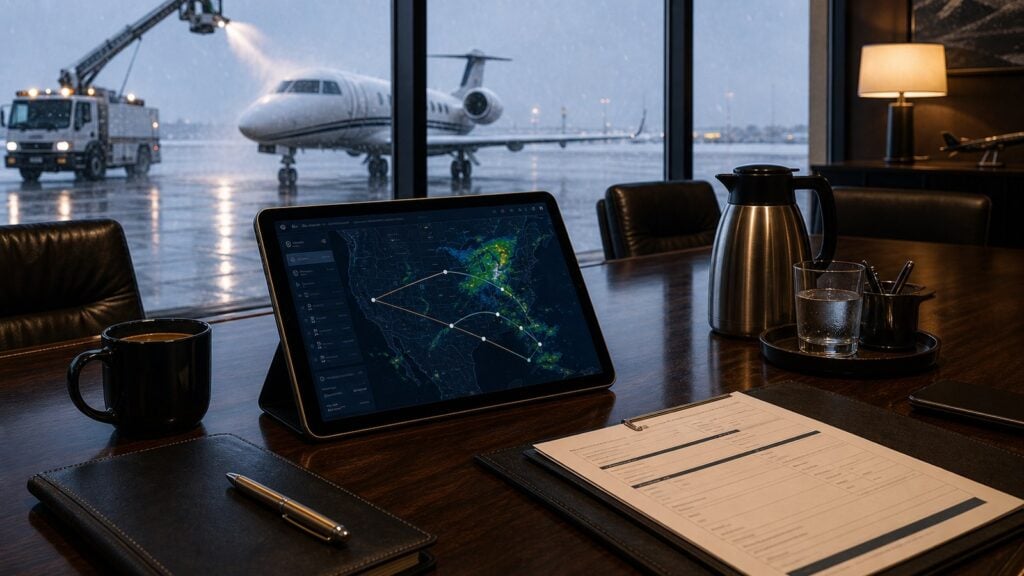
Private Jet Deicing Fees: What Winter Travelers Should Clarify Before Trusting a Quote
Private jet deicing fees can change a winter quote. Learn what buyers should clarify about billing, airports, delays, aircraft size, and written approval.
Why this matters
TimeMake faster private aviation decisions without wading through fluff.
ControlGet clearer frameworks around pricing, timing, routing, and aircraft choice.
Peace of MindReduce friction for business travel, family logistics, and last-minute schedule shifts.
Table of Contents
- 1. Private Jet Deicing Fees: What Winter Travelers Should Clarify Before Trusting a Quote
- 2. Quick answer: what should private jet buyers ask about deicing fees?
- 3. Why deicing belongs in the quote conversation before winter travel
- 4. Deicing is not a luxury surcharge
- 5. Included, estimated, pass-through, or post-trip billing
- 6. Why the same route can have different deicing exposure
- 7. Airport choice can change winter cost and control
- 8. Delays can turn one deicing assumption into a different problem
- 9. Aircraft size and mission profile matter
- 10. The lower quote may not be the better quote
- 11. What executive assistants and family offices should get in writing
- 12. Red flags in private jet deicing conversations
- 13. Buyer checklist: deicing questions before approving a winter private jet quote
- 14. Cost and billing
- 15. Airport and route
- 16. Timing and delays
- 17. Aircraft and mission fit
- 18. Written approval
- 19. FAQ: private jet deicing fees
- 20. Are private jet deicing fees included in charter quotes?
- 21. Why can private jet deicing cost vary?
- 22. Should travelers ever refuse deicing to avoid a fee?
- 23. How should I compare winter private jet quotes?
- 24. What should an executive assistant ask before approving a winter trip?
- 25. Final thought: protect the winter mission, not just the quote
Private Jet Deicing Fees: What Winter Travelers Should Clarify Before Trusting a Quote

Private jet deicing fees are easy to misunderstand because they appear at the intersection of weather, safety-related operations, airport billing, aircraft size, departure timing, and quote language.
That makes them dangerous to ignore.
JetMaster’s view is direct: deicing fees are not the problem. Unclear weather-cost assumptions are the problem. A winter private jet quote can look clean, polished, and ready for approval while still leaving one of the most variable seasonal cost items poorly explained.
For a serious traveler, founder, family office, executive assistant, or frequent winter flyer, that vagueness matters. Deicing can affect the final invoice, departure sequence, airport choice, timing expectations, and how confidently the traveler can approve a ski trip, holiday itinerary, board meeting, Northeast return, Midwest reposition, Canada routing, or Europe winter schedule.
JetMaster Executive Briefing
Start The Free Course
Make Your Next Private Flight Decision With More Control
Get the free 10-day JetMaster course built for founders, CEOs, investors, and business owners who value time, cost clarity, family convenience, safety, and smarter private aviation decisions.
This article does not price deicing, operate aircraft, make safety decisions, validate invoices, advise travelers to avoid required procedures, guarantee availability, or claim that any provider’s terms are correct. It gives private travelers a buyer-protection framework for asking better questions before approving a winter private jet quote.
For related JetMaster planning context, pair this guide with the articles on private jet charter cost transparency, private jet quote assumptions, private jet fuel surcharges, private jet airport choice, private jet route cost, private jet repositioning fees, and private jet cancellation policy.
Quick answer: what should private jet buyers ask about deicing fees?
Before approving a winter private jet quote, buyers should ask whether deicing is included, estimated, excluded, billed as a pass-through, reconciled after the trip, or handled by the airport, FBO, operator, or provider under separate terms. They should also ask how airport choice, aircraft size, weather timing, overnight frost, delays, departure sequencing, route changes, and schedule changes can affect deicing exposure.
Clarify these points in writing:
- Is deicing included in the quoted price, or is it separate?
- If included, what exactly is included and what is not?
- If estimated, how will the final amount be reconciled?
- If pass-through, who bills it and what documentation will be provided?
- Is deicing charged by airport, FBO, operator, aircraft type, fluid usage, time, service, or another method?
- Can the same itinerary have different deicing exposure at different airports?
- What happens if the aircraft must be deiced more than once because of delay or weather recurrence?
- How do delays, late passengers, crew duty, airport hours, and departure sequencing affect the plan?
- If an alternate airport is used, how does that affect deicing and ground-transfer assumptions?
- What will appear on the final invoice if deicing is needed?
The point is not to demand a fake fixed number when weather cannot be known in advance. The point is to know whether the quote is giving you a real winter assumption or only a calm-looking headline price.
Why deicing belongs in the quote conversation before winter travel

Many private aviation buyers think about deicing only when they see a truck near the aircraft.
That is too late for quote comparison.
In winter private aviation, deicing belongs in the planning conversation before approval because it can be legitimate, necessary, variable, and hard to compare across quotes. A provider may handle it one way. Another may present a lower headline quote and leave deicing as a separate operational item. A third may estimate it but reconcile later. A fourth may explain that the charge depends on conditions at departure and cannot be finalized until the service is performed.
None of those structures is automatically wrong. The problem is when the buyer cannot tell which structure is being used.
A winter trip is not a summer trip with colder scenery. It can include frost, snow, freezing rain, contaminated surfaces, cold-soaked aircraft, airport congestion, deicing queues, changing departure slots, runway treatment, FBO coordination, and weather-driven timing decisions. Even if the cabin experience remains calm and private, the operational environment outside the cabin can be more complex.
That complexity should not be hidden behind vague language such as:
- “It should be fine.”
- “We will handle it.”
- “That is usually not a big deal.”
- “We can talk about that later.”
- “The quote is all-inclusive,” without explaining what all-inclusive means.
A serious buyer does not need alarmism. He needs clarity.
The correct winter question is not, “Can you guarantee no deicing cost?” A serious provider may not be able to promise that honestly. The better question is, “How is deicing handled if it is required, and what will I see before or after the trip?”
Deicing is not a luxury surcharge
One of the worst ways to think about deicing is to treat it as a luxury surcharge.
It is not champagne, catering preference, cabin decoration, or optional service polish. Deicing is tied to weather and safety-related operational decisions. If the aircraft needs treatment before departure, the traveler should not frame that as a negotiable add-on or a provider trick. The buyer-protection issue is not whether required deicing should happen. The issue is whether the financial and timing assumptions were explained before the traveler approved the trip.
That distinction matters.
JetMaster does not tell travelers when deicing is required. That decision belongs to the relevant aviation professionals, operating procedures, airport environment, aircraft condition, weather situation, and safety-related judgment. A passenger should never pressure a crew, operator, or provider to skip necessary treatment to protect a quote.
But the buyer can and should ask how the commercial side is handled:
- Is deicing included in the quote?
- Is there an estimate?
- Is it billed at actual cost?
- Will the buyer see supporting documentation?
- Does the provider apply a markup or administrative fee?
- Does the policy differ by airport, aircraft, or itinerary?
- How does the provider communicate deicing exposure before departure?
The strongest private aviation buyers separate operational judgment from commercial ambiguity. They do not argue with safety-related procedures. They do ask for the cost logic in writing.
Included, estimated, pass-through, or post-trip billing

The phrase “private jet deicing fees” can hide several different billing structures.
A quote might include deicing under certain conditions. It might exclude it entirely. It might show an estimate. It might state that deicing is billed at actual cost. It might treat the charge as a pass-through from the airport, FBO, operator, or service provider. It might appear after the trip if deicing was required unexpectedly. It might be bundled into a broader winter-operations line item. It might be referenced only in terms and conditions rather than the headline quote.
The buyer should not assume that the cleanest-looking quote is the most complete quote.
A lower winter quote can be less comparable if one provider has included a realistic assumption and another has left the item open. Conversely, a quote with a separate deicing note may look less attractive at first but may actually be more transparent.
Ask these questions before approval:
- Is deicing included in the quoted total?
- If it is included, is there a cap, condition, airport limitation, or aircraft limitation?
- If it is excluded, where is that stated?
- If it is estimated, what happens if the actual charge is higher or lower?
- If it is pass-through, will the final invoice show the source or supporting charge?
- Is any administrative fee, coordination fee, margin, or markup applied?
- Will the traveler be notified before deicing is performed, or only after the trip?
- If weather changes while passengers are delayed, can a second deicing cycle be needed?
- Does the policy differ for outbound, return, overnight, or multi-leg segments?
This is not a demand for perfect prediction. It is a demand for honest quote architecture.
A winter quote that says “deicing billed separately if required” may be acceptable if the buyer understands the exposure. A winter quote that says nothing, then surprises the traveler later, creates a trust problem.
Why the same route can have different deicing exposure
Private travelers often compare quotes by route, aircraft category, departure time, and cabin standard. In winter, that is not enough.
The same route can have different deicing exposure depending on the airport, aircraft, weather timing, overnight conditions, ramp location, departure sequence, prior leg, aircraft size, FBO arrangement, and whether the aircraft has been sitting outside. Even a familiar city pair can behave differently on a cold morning after overnight frost than it does on a dry afternoon.
That means “private jet deicing cost” is not one simple number that applies universally to every trip.
Factors that can change exposure include:
- Departure airport weather and temperature.
- Whether snow, ice, frost, or freezing precipitation is present.
- Whether the aircraft sat outside overnight.
- Aircraft size and surface area.
- Airport or FBO deicing process.
- Local queue and departure sequencing.
- Fluid type, volume, timing, and service method.
- Whether the aircraft must be treated again after a delay.
- Whether the trip uses a different airport from the original plan.
- Whether the return segment faces different winter conditions.
A buyer does not need to become an airport operations expert. But he should resist false precision.
If a provider gives a very confident answer without asking about airport, timing, aircraft, or conditions, that confidence may not be as useful as it sounds. A better answer may be more nuanced: “Here is how we handle it, here is what is included or excluded, here is how it is documented, and here is when you would know.”
Private aviation buyers often prefer certainty. Winter operations sometimes require disciplined uncertainty. The goal is not perfect certainty. The goal is transparent uncertainty.
Airport choice can change winter cost and control
nn
Airport choice is one of the most underrated winter planning decisions.
A buyer may choose an airport for convenience, proximity to a home, proximity to a ski resort, privacy, ground-transfer time, runway suitability, customs, parking, or schedule control. In winter, the same airport choice can also affect deicing availability, departure sequencing, weather exposure, FBO coordination, runway treatment, and delay risk.
A closer airport is not always the better winter airport. A larger airport is not always the easier airport. A quieter airport is not always operationally simpler. A preferred airport may be excellent most of the year and more sensitive during winter weather events.
Before approving a quote, ask:
- Is the proposed airport the best winter choice for this mission, or only the closest convenient field?
- Are deicing services normally available for the proposed aircraft category at the expected time?
- Does the airport have known winter congestion, limited hours, or sequencing issues?
- If the airport becomes impractical, what alternate airport is realistic?
- Who pays for additional ground transfer if an alternate airport is used?
- Does switching airports affect deicing, handling, repositioning, crew duty, or cancellation terms?
- Will a different airport make the quote more honest even if the drive is longer?
This is where private aviation decision quality becomes practical. The best winter itinerary is not always the one that looks most elegant on the first quote. It is the one where the airport, timing, aircraft, ground plan, and weather assumptions make sense together.
For a family ski trip, that may mean choosing a more resilient airport and accepting a longer ground transfer. For a board meeting return, it may mean departing earlier to reduce weather and crew-duty exposure. For an assistant coordinating a principal’s itinerary, it may mean asking for the alternate airport plan before the principal signs off.
Delays can turn one deicing assumption into a different problem
Winter operations are sensitive to timing.
A traveler may think, “If deicing is needed, they deice and we go.” Sometimes the process may be that straightforward from the passenger’s perspective. But the quote and schedule implications can become more complicated if timing changes.
Consider what can happen when passengers are late, a meeting runs long, weather changes, a slot shifts, or departure sequencing slows down. Depending on the conditions and process, deicing may need to happen at a specific point before departure. If the aircraft is treated and then the flight does not depart within the operationally acceptable window, additional coordination or treatment may be required. If conditions continue to accumulate, the original assumption can change.
Again, JetMaster is not giving operational instruction. The buyer-facing point is simple: winter delays can create cost and schedule consequences that a normal quote conversation may not surface unless the buyer asks.
Ask:
- What happens if passengers are late on a deicing-sensitive departure?
- Could a delay require additional deicing or a different departure sequence?
- If deicing is performed and departure is delayed, how are additional costs handled?
- Does waiting time interact with crew duty, airport hours, or aircraft positioning?
- What happens if the return segment is delayed into worse winter conditions?
- If weather creates a long ground delay, what communication should the traveler expect?
- Are schedule-change costs separate from deicing costs?
The buyer should not turn this into a fear exercise. Most private travelers do not need a lecture on every technical detail. They need to know whether the commercial plan assumes an on-time passenger, a flexible delay window, a single treatment, a realistic alternate, or a best-case scenario.
Best-case assumptions are fine when labeled as best case. They are risky when disguised as certainty.
Aircraft size and mission profile matter
Aircraft category can also affect winter cost exposure.
A light jet, midsize jet, super midsize jet, large cabin aircraft, and long-range aircraft may involve different surface area, service requirements, airport handling, runway considerations, luggage plan, passenger expectations, and mission profile. A ski itinerary with heavy luggage, a large family group, and a mountain destination is not the same planning problem as a simple executive point-to-point trip.
That does not mean larger aircraft are automatically wrong or that smaller aircraft are automatically cheaper in a meaningful total-cost sense. It means the quote should connect aircraft choice to winter realities.
Ask:
- Does the proposed aircraft category change deicing exposure?
- Is the aircraft expected to remain outside before departure?
- Does the route, luggage, passenger count, runway, or weather profile make this aircraft a sensible winter fit?
- If the aircraft category changes, do deicing, handling, airport, and route assumptions change too?
- If an aircraft substitution occurs, how are winter operational costs handled?
- Does the quote compare total mission fit or only hourly price?
This is where cheap-looking precision can mislead. An aircraft may look less expensive by hourly number but less appropriate for the winter mission. Another aircraft may appear more expensive but better aligned with range, baggage, passenger comfort, runway needs, and schedule resilience. Deicing is only one part of that decision, but it belongs in the same conversation.
A serious winter quote should not isolate aircraft category from airport choice, weather timing, deicing exposure, and route control.
The lower quote may not be the better quote

This is the contrarian part: the winter quote with the lowest headline number may be the least useful quote if it does not explain deicing and weather-cost assumptions.
Private aviation buyers often know not to compare only hourly rates. They have learned to ask about repositioning, billable flight hours, fuel surcharges, airport choice, catering, international fees, crew overnight, and cancellation terms. Deicing belongs in that same quote-comparison discipline.
A lower quote can be weaker if it leaves open questions such as:
- Deicing excluded without emphasis.
- Weather delay policy unclear.
- Alternate airport plan missing.
- Airport choice chosen for convenience, not winter resilience.
- Aircraft substitution terms vague.
- Pass-through costs undefined.
- No documentation standard for post-trip billing.
- No explanation of passenger delay consequences.
- No written plan for multi-leg winter segments.
A higher quote can still be too high, incomplete, or poorly structured. Transparency does not automatically make a quote good. But lack of transparency makes comparison unreliable.
The buyer’s job is not to punish every variable. Variables are part of real aviation. The buyer’s job is to identify which variables are visible, documented, and reasonably explained before approval.
A winter quote that says, “Deicing, if required, is billed at actual cost and documented after service,” may not feel as clean as an all-in number. But it gives the buyer a clear assumption. A quote that buries the issue until after departure may create a worse experience even if the initial number looked more attractive.
What executive assistants and family offices should get in writing
Executive assistants and family offices often carry the practical burden of private aviation decisions. They may be asked to present a quote, coordinate preferences, protect the traveler’s schedule, brief family members, control budget exposure, and answer questions after the invoice arrives.
For winter travel, they should not rely on casual reassurance.
Before approval, request written clarity on:
- Deicing inclusion or exclusion.
- Estimate methodology, if any.
- Pass-through billing standard.
- Documentation provided after deicing.
- Airport-specific assumptions.
- Aircraft-specific assumptions.
- Departure-time sensitivity.
- Passenger-delay consequences.
- Alternate airport plan.
- Weather delay communication.
- Crew duty or overnight sensitivity, if relevant.
- Cancellation or schedule-change interaction.
- Who approves changes when weather affects the plan.
The goal is not to create a 40-page memo for a simple trip. The goal is to make sure the principal is not approving a polished number while the assistant is left to explain an avoidable ambiguity later.
A concise written note is often enough:
“Deicing is not included in the quoted total. If required, it will be billed as a pass-through based on the airport/FBO/operator charge, with documentation after the trip. Passenger delays or weather changes may require additional treatment or revised timing. Alternate airport use may affect ground transfer, deicing, handling, and schedule assumptions.”
That kind of note may not remove the cost. It removes the surprise.
Red flags in private jet deicing conversations
The presence of a deicing fee is not a red flag by itself. Vague handling is the red flag.
Be cautious when you hear:
- “Do not worry about it,” without written explanation.
- “It is all included,” without defining what is included.
- “It almost never happens,” for a winter, mountain, Canada, Northeast, Midwest, or Europe itinerary.
- “We will know later,” with no billing standard.
- “That depends,” with no explanation of what it depends on.
- “Just approve now and we can sort it out,” when the trip is weather-exposed.
- “This quote is cheaper,” while excluding winter operational assumptions.
- “The aircraft is available,” without discussing airport and weather timing.
- “The airport is closest,” without discussing winter resilience or alternate plans.
- “There is no need to put that in writing.”
The most serious warning sign is not uncertainty. Honest uncertainty is normal in winter operations. The warning sign is certainty without structure.
A premium private aviation conversation should be able to say: “Here is what we know, here is what we cannot know yet, here is how it will be handled, and here is what you will see on the invoice.”
That is the level of clarity affluent travelers should expect before approving the trip.
Buyer checklist: deicing questions before approving a winter private jet quote
Use this checklist before approving a winter, ski, mountain, holiday, Northeast, Midwest, Canada, Europe, or weather-exposed private jet itinerary.
Cost and billing
- Is deicing included, excluded, estimated, capped, or billed separately?
- If included, what conditions or limits apply?
- If excluded, how will the charge be calculated or passed through?
- Will the invoice show documentation or source charges?
- Is any markup, coordination fee, or administrative fee applied?
- Is the treatment different for outbound, return, overnight, or multi-leg segments?
Airport and route
- Is the proposed airport a strong winter choice for this mission?
- Are deicing services expected to be available for the aircraft category and departure time?
- What alternate airport would be used if the original airport becomes impractical?
- Who pays for extra ground transfer if an alternate airport is used?
- Does changing airports affect handling, repositioning, crew duty, deicing, or cancellation terms?
Timing and delays
- What happens if passengers are late?
- Could delay require additional deicing or revised sequencing?
- How are weather delays communicated?
- Does waiting time interact with crew duty or airport hours?
- What happens if the return is delayed into worse weather?
- Are schedule changes priced separately from deicing?
Aircraft and mission fit
- Does aircraft category affect deicing exposure?
- Is the aircraft expected to sit outside before departure?
- Does the aircraft fit the winter route, luggage, passenger count, runway, and timing plan?
- If aircraft substitution occurs, how are winter operational costs handled?
- Is the comparison based on total mission fit or only a headline number?
Written approval
- Where is deicing addressed: quote, contract, terms, email, or invoice policy?
- Who has authority to approve weather-related changes?
- What costs require traveler approval before action, and what costs are handled operationally and billed after?
- What documentation will the buyer receive after the trip?
- What exact assumptions should be understood before approval?
FAQ: private jet deicing fees
Are private jet deicing fees included in charter quotes?
Sometimes they may be included, estimated, excluded, or billed separately as a pass-through or post-trip operational charge. Buyers should not assume one structure applies universally. Ask the provider to state in writing whether deicing is included, what limits apply, and how any required deicing will appear on the final invoice.
Why can private jet deicing cost vary?
Deicing exposure can vary because of airport conditions, aircraft size, weather timing, frost or snow accumulation, local service process, fluid or service requirements, departure sequencing, delays, and whether treatment must happen more than once. The buyer does not need to know every technical factor, but should understand how the provider handles variable winter charges.
Should travelers ever refuse deicing to avoid a fee?
No. Travelers should not pressure crews, operators, providers, or airport teams to avoid necessary safety-related procedures. The buyer-protection issue is commercial clarity, not operational interference. Ask how deicing is handled financially, but do not treat required deicing as an optional luxury item.
How should I compare winter private jet quotes?
Compare the total mission assumptions, not only the headline price. Review deicing language, weather delay policy, airport choice, alternate airport plan, aircraft fit, repositioning, fuel surcharges, cancellation terms, passenger-delay consequences, and how pass-through costs are documented. A lower quote may be less useful if key winter assumptions are vague.
What should an executive assistant ask before approving a winter trip?
An executive assistant should ask whether deicing is included or separate, how it is estimated or billed, what documentation will be provided, how delays affect exposure, whether the proposed airport is winter-resilient, what alternate airport plan exists, and which assumptions must be approved in writing before the principal commits.
Final thought: protect the winter mission, not just the quote
Private jet deicing fees should not be treated as a surprise, a scare tactic, or a casual afterthought.
They are part of winter mission planning.
The buyer does not need fake certainty. He needs a clear explanation of what is included, what is variable, what is passed through, what depends on airport and weather, and what happens if timing changes.
That is the difference between a quote that merely looks polished and a quote that supports a controlled decision.
Before approving a winter private jet itinerary, ask for the deicing and weather-cost assumptions in writing. The strongest private aviation decisions are not built on the lowest headline number. They are built on visible assumptions, honest variables, and calm control before the aircraft is ever positioned.
Use JetMaster’s private aviation planning guides to prepare better questions before comparing winter quotes, airport choices, aircraft categories, weather policies, and final trip approvals.