Private Jet Catering: What Buyers Should Confirm Before They Assume It Is Handled
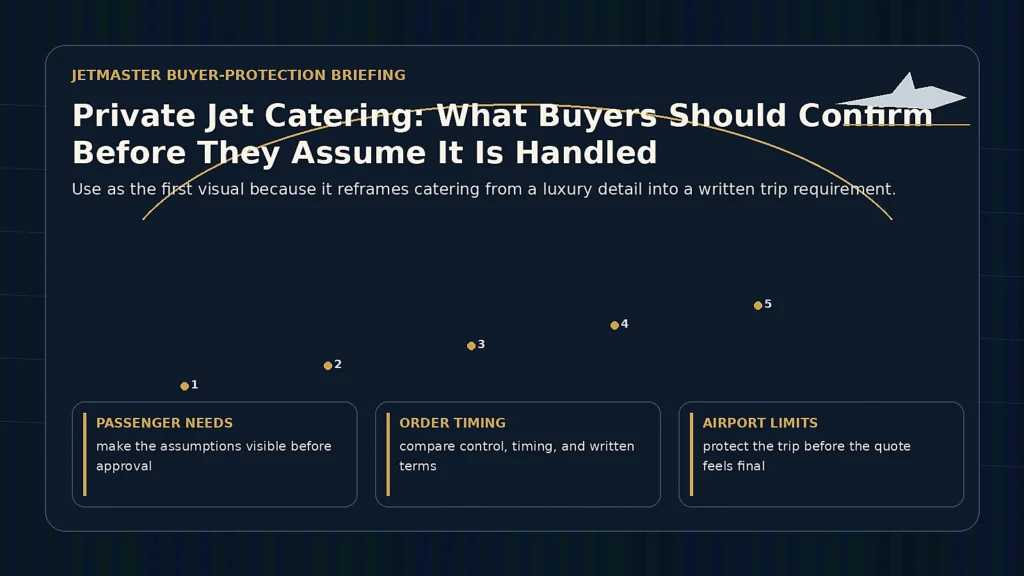
Private jet catering works best when it is treated as a written trip requirement, not an assumption. Serious buyers should confirm passenger needs, timing, airport limits, cost treatment, and change rules before the flight is considered ready.
Why this matters
TimeMake faster private aviation decisions without wading through fluff.
ControlGet clearer frameworks around pricing, timing, routing, and aircraft choice.
Peace of MindReduce friction for business travel, family logistics, and last-minute schedule shifts.
Table of Contents
- 1. Quick answer: what should buyers confirm about private jet catering?
- 2. Why catering deserves executive attention
- 3. The first question: what is actually included?
- 4. Catering is a timing problem, not just a menu problem
- 5. Dietary restrictions and allergies must be written, not casually mentioned
- 6. Airport and FBO limits can matter more than the passenger’s expectations
- 7. Packaging, presentation, and onboard service should match the trip
- 8. Cost clarity: included, allowance, estimate, markup, or pass-through?
- 9. Delay, cancellation, and re-catering rules should be clarified early
- 10. International flights may add extra limitations
- 11. Alcohol and special requests need policy clarity
- 12. The executive assistant’s private jet catering checklist
- 13. What not to do when requesting private jet catering
- 14. How to compare two private jet catering approaches
- 15. Private jet catering questions to ask before approval
- 16. A practical approval memo for private jet catering
- 17. Final thought: private jet catering should reduce friction, not create assumptions
- 18. FAQ: private jet catering
- 19. What is private jet catering?
- 20. Is food included on a private jet?
- 21. How far in advance should private jet catering be requested?
- 22. Can private jet catering handle allergies or dietary restrictions?
- 23. What happens to catering if a private flight is delayed?
- 24. Why can private jet catering cost more than expected?
- 25. What should an executive assistant confirm before ordering private jet catering?
- 26. JetMaster buyer-protection next step
Private jet catering is easy to misunderstand because it looks like a luxury detail.
It is not.
For a serious private traveler, catering is a trip requirement. It affects passenger comfort, meeting performance, family travel, guest experience, timing, allergy risk, invoice clarity, and whether the flight feels controlled or improvised.
A polished aircraft and a vague catering assumption can still produce a poor trip. The principal boards after a long meeting and the wrong meal is onboard. A child’s food was never requested. A guest has a dietary restriction no one confirmed. The departure time changes and the food timing no longer works. The selected airport has limited options at that hour. A special request is treated as possible until the day of departure, then replaced with something generic. The invoice later shows catering as a separate pass-through charge that the approver did not expect.
JetMaster Executive Briefing
Start The Free Course
Make Your Next Private Flight Decision With More Control
Get the free 10-day JetMaster course built for founders, CEOs, investors, and business owners who value time, cost clarity, family convenience, safety, and smarter private aviation decisions.
None of this means private jet catering is inherently unreliable. Many providers, operators, FBOs, handlers, and catering vendors do excellent work when the requirements are clear and realistic.
The buyer-protection problem is different: catering is often discussed casually when it should be documented precisely.
The contrarian rule is simple: do not assume catering is handled because the flight is private. Assume it is handled only when the passenger requirements, timing, limitations, substitutions, cost treatment, and change rules are written clearly enough for the trip’s stakes.
This article is not food-safety, medical, allergy, legal, tax, aircraft-operator, or vendor-selection advice. JetMaster is not an aircraft operator, air carrier, broker, caterer, medical provider, food-safety authority, or safety certifier. This is a buyer-protection framework for private travelers, executive assistants, family offices, and travel planners who want fewer assumptions before approving a trip.
For broader planning context, pair this guide with JetMaster’s articles on private jet quote assumptions, private jet hidden costs, private jet luggage capacity, private jet with pets, private jet airport choice, private jet cancellation policy, and private jet charter payment terms.
Quick answer: what should buyers confirm about private jet catering?
Before approving a private flight, buyers should confirm what catering is included, what must be requested separately, how much notice is required, whether dietary restrictions and allergies are documented, whether the requested menu is realistic at the airport and departure time, how delays or schedule changes affect food, and whether catering is included in the quote, estimated, marked up, or billed later as a pass-through.
At minimum, a serious buyer or assistant should clarify:
- Passenger count and guest profile.
- Meal timing relative to departure, arrival, meetings, and time zones.
- Dietary restrictions, allergies, preferences, and dislikes.
- Children’s meals or family-specific needs.
- Whether alcohol, specialty items, or celebratory items are permitted or practical.
- Airport, FBO, and vendor limitations.
- Required advance notice for non-standard requests.
- Packaging, presentation, reheating, and service expectations.
- What happens if departure time changes.
- What happens if a passenger changes.
- What catering is included, estimated, pass-through, or billed after the flight.
- Who confirms the final order and by what deadline.
The practical rule: catering should be managed like any other private aviation assumption. If it matters to the passenger experience, put it in the request and confirm how it will be handled.

Why catering deserves executive attention
Affluent travelers do not need theatrical language about champagne, caviar, and luxury dining.
They need the trip to work.
A founder flying between investor meetings may need a clean, reliable meal at the right time because there is no room in the day for a restaurant stop. A family traveling with children may need specific snacks, bottles, simple meals, or allergy-safe planning. A principal hosting guests onboard may care about hospitality because the aircraft is part of the day’s impression. An executive assistant may need to know whether the provider can actually source the requested items at a smaller airport on short notice. A family office may need invoice detail because catering is not automatically treated the same way by every provider or trip.
Private aviation is attractive because it gives the traveler more control than scheduled airline travel. But control depends on details being specified. Catering is one of those details.
A vague request such as “premium catering” is weak. So is “standard catering is fine” when the flight is long, passengers have restrictions, the departure is early, or the itinerary includes children, older relatives, VIP guests, or a demanding meeting schedule.
Better language is concrete:
- “Two passengers, one vegetarian, one gluten-free; no shellfish; light breakfast after boarding.”
- “Children onboard; simple snacks and water accessible before takeoff.”
- “Principal has back-to-back meetings and prefers a clean protein-forward lunch, no heavy sauces.”
- “Guest group expects coffee service and individually packaged lunches.”
- “Please confirm what is realistic from this airport at this departure time.”
That is not being difficult. It is preventing avoidable friction.
The first question: what is actually included?
Private jet catering can be presented in different ways depending on provider, aircraft, operator, aircraft category, route, airport, timing, and trip type.
Some flights may include basic snacks and beverages. Some may include a light standard catering setup. Some may include a catering allowance. Some may treat special catering as an estimate or pass-through. Some may quote specific requested items. Some may add vendor, handling, delivery, service, or administrative charges. Some may reconcile final charges after the flight.
The buyer should not assume one universal standard.
Ask:
- What catering is included in the quoted amount?
- Is the included catering basic snacks and beverages, a standard menu, or a specific requested order?
- Are special requests included, estimated, or billed separately?
- Is there a catering allowance?
- If there is an allowance, what happens if the order exceeds it?
- Are delivery, handling, service, or administrative charges included?
- Will catering appear as a separate invoice line?
- Can final catering charges change after the flight?
- Who approves the final order before it is placed?
This matters because the phrase “catering included” may not mean what the buyer imagines. It may mean basic onboard provisions, not a custom restaurant-style meal for every passenger. It may mean a standard offering, not special dietary sourcing. It may mean the provider has included an estimated amount but not guaranteed final vendor pricing.
A private jet quote should not be judged only by whether it says catering. It should be judged by whether the catering assumption matches the trip.
Catering is a timing problem, not just a menu problem

A menu that sounds reasonable can become unrealistic if the timing is wrong.
Private aviation schedules move. Passengers run late. Meetings extend. Weather changes the plan. Aircraft positioning shifts. Airport operating hours matter. Caterers may need order cutoffs. FBOs may have local limitations. Early departures, late departures, holidays, remote airports, and last-minute bookings can reduce options.
That is why catering should be connected to the itinerary.
Ask:
- What is the catering order deadline?
- What time will the order be placed?
- What happens if the departure time moves earlier?
- What happens if the departure time moves later?
- Can the food be refreshed or replaced if the aircraft waits?
- Are there local vendor limitations at the departure airport?
- Does this airport have reliable catering at the requested time?
- Are holiday, weekend, or after-hours limitations relevant?
- If the aircraft changes, does the catering order still work?
- Who updates the catering vendor if the itinerary changes?
This is especially important for early-morning departures, evening returns, smaller airports, multi-leg days, international departures, and trips planned close to departure.
A strong private jet catering request is not “we want lunch.” It is “we want lunch that fits this departure time, this passenger list, this airport, and this aircraft plan.”

Dietary restrictions and allergies must be written, not casually mentioned
Dietary restrictions deserve more than a casual note in a text thread.
If a passenger has an allergy, religious dietary requirement, medical restriction, strong intolerance, or critical preference, the request should be documented and confirmed through the provider’s normal process. The buyer should also understand that private aviation providers and catering vendors may have limitations and may not be able to guarantee every condition in the same way a medical environment would.
Do not rely on vague language such as:
- “One person is kind of gluten-free.”
- “No nuts if possible.”
- “Healthy options preferred.”
- “Something vegetarian-ish.”
- “The kids are picky.”
Use precise language:
- Passenger A: vegetarian, no fish.
- Passenger B: severe nut allergy; please confirm whether vendor can accommodate and disclose limitations.
- Passenger C: gluten-free preference, not medical allergy.
- Children: plain pasta, fruit, crackers, bottled water.
- Principal: no dairy, light lunch, no heavy sauces.
Then ask for confirmation:
- Has the restriction been sent to the catering vendor?
- Has the vendor confirmed it can be accommodated?
- Are there cross-contact limitations or disclaimers we should understand?
- Will items be labeled?
- Who verifies the order before it is loaded?
- If the exact request cannot be fulfilled, what is the substitute?
This is not about turning JetMaster into a food-safety authority. It is about preventing a private flight from becoming an avoidable passenger-experience problem.
For family travel and executive guest travel, documented catering requirements are part of the same planning discipline as passenger names, luggage, pets, customs, arrival transport, and ground timing.
Airport and FBO limits can matter more than the passenger’s expectations
Private jet travelers sometimes assume that because the aircraft is private, any catering request can be met.
That assumption is risky.
The available catering options may depend on the departure airport, nearby vendors, FBO procedures, aircraft timing, security, customs, delivery windows, local holidays, order cutoffs, and whether the aircraft is departing from a major private aviation hub or a smaller field.
A major airport-area FBO near a large city may offer strong vendor access. A small regional airport late at night may not. An international trip may add customs, import, alcohol, packaging, or handling considerations. A last-minute aircraft substitution may require re-confirmation of what can be loaded and where.
Ask:
- Is the requested catering realistic at this airport?
- Is it realistic at this time of day?
- Is the FBO or caterer able to handle the request?
- Are there cutoffs for specialty items?
- Are there limitations on alcohol, fresh food, international items, or outside food?
- If the exact item is unavailable, what substitute will be used?
- Can the provider confirm the final menu before departure?
- Does the aircraft have the galley equipment or storage needed for the request?
The practical standard is not “can you get premium catering?” The practical standard is “can this aircraft, at this airport, at this time, with these passengers, reliably support this request?”
That question protects the buyer from expectation gaps.
Packaging, presentation, and onboard service should match the trip
Private jet catering is not only about food selection. It is also about how the food appears and functions onboard.
A long executive day may call for clean, easy-to-eat meals that do not interfere with work. A family trip may need accessible snacks and minimal mess. A guest flight may require a more polished presentation. A short reposition-style hop may need only beverages and simple provisions. A longer international sector may require staged meal timing and more thought around freshness, storage, and service.
Ask:
- Will meals be individually packaged or plated?
- Are utensils, napkins, cups, serving items, and condiments included?
- Will hot items need reheating, and can the aircraft support that?
- Is the food practical for turbulence, laptop work, children, or formal guests?
- Will items be labeled for dietary restrictions?
- Who handles setup and service onboard?
- Are there limits based on aircraft size, galley, storage, or crew procedure?
A menu may look impressive on paper but perform poorly in the cabin. Heavy sauces, fragile plating, complicated service, strong odors, or messy items can be wrong for a working flight even if they sound premium.
Private aviation buyers should think in terms of trip fit, not culinary theater.
Cost clarity: included, allowance, estimate, markup, or pass-through?

Catering cost clarity matters because it can sit in a gray zone between hospitality and trip expense.
A buyer may see a quote and assume catering is fully included. Another provider may show catering as a separate estimate. Another may include basic provisions but treat special requests as pass-through. Another may add service or administrative charges. Another may reconcile final vendor costs after the trip.
None of these structures is automatically wrong. The problem is approving a flight without knowing which structure applies.
Ask:
- Is catering included in the quote?
- If included, what exactly is included?
- Is there a per-passenger allowance?
- Is special catering quoted separately?
- Are vendor charges passed through at cost, marked up, or subject to service fees?
- Are delivery, FBO handling, packaging, or after-hours charges included?
- Can final catering costs change after the flight?
- Will we receive an itemized catering invoice or summary?
- Who must approve any catering amount above the estimate?
This is where private jet catering connects to broader quote discipline. A quote that looks precise may still contain estimated or variable items. Catering is one of the areas where “small detail” thinking can lead to approval friction later.
For executive assistants and family offices, the cleanest approach is to summarize the catering treatment before approval:
- Included baseline.
- Requested additions.
- Estimated cost or allowance.
- Pass-through or markup treatment.
- Approval threshold.
- Change/cancellation rule.
- Person responsible for final confirmation.
That turns a soft service expectation into a controlled trip assumption.

Delay, cancellation, and re-catering rules should be clarified early
A private flight can change after catering is ordered.
That creates practical questions:
- If the trip is delayed, does the catering remain usable?
- If departure moves by several hours, can the order be refreshed?
- If the departure date changes, can the order be cancelled?
- If the passenger list changes, can the order be adjusted?
- If the aircraft changes airports, what happens to the existing order?
- If weather, maintenance, airport restrictions, or crew timing affect the trip, who manages catering updates?
- Are catering cancellation fees possible?
- When does the order become non-refundable or non-cancellable?
Buyers should not expect every catering item to remain flexible until departure. Vendors, kitchens, delivery teams, FBOs, and aircraft schedules have real constraints. Specialty items may have firm deadlines. Late changes may create extra cost or limited alternatives.
The buyer-protection standard is not “never pay for changed catering.” It is “know the change logic before the schedule changes.”
This is particularly important for high-stakes trips: board meetings, weddings, sporting events, holidays, investor roadshows, medical-adjacent family travel, or any flight with VIP guests.
International flights may add extra limitations
International private aviation can make catering more complex.
Depending on the route and countries involved, there may be customs, agricultural, alcohol, packaging, waste, import, or handling considerations. Certain items may be restricted. Fresh food may be treated differently. Catering loaded in one country may not be practical or permitted for every leg. Arrival and departure rules can affect what stays onboard and what must be disposed of or declared.
The buyer does not need to become an international catering expert. But the buyer should not assume that a domestic catering request automatically transfers cleanly to an international itinerary.
Ask:
- Are there international restrictions on any requested items?
- Can alcohol, fresh food, specialty products, or outside items be loaded for this route?
- Will any catering need to be disposed of before arrival or onward travel?
- Are customs or agricultural rules relevant?
- Does the return leg need a separate catering plan?
- Are local vendors available at the return airport?
- Who confirms what is permitted?
The safest executive posture is simple: ask the provider to flag any catering limitations tied to the route before the passenger treats the menu as final.
Alcohol and special requests need policy clarity
Alcohol, celebratory items, cigars, specialty products, luxury restaurant requests, branded gifts, and other special items can create expectation gaps.
A passenger may assume that almost anything can be arranged. In reality, the provider may need to consider regulations, operator policy, aircraft rules, customs, storage, crew procedures, vendor availability, and passenger conduct. Alcohol service in particular can involve provider-specific and route-specific considerations.
Ask:
- Are alcoholic beverages permitted for this flight and route?
- Who supplies them?
- Are there limits or service rules?
- Are outside items allowed onboard?
- Are special items subject to extra sourcing fees or deadlines?
- Can branded or celebratory items be loaded without creating operational issues?
- Are there customs or international restrictions?
- What happens if the requested item is unavailable?
The correct tone is not suspicious. It is professional. A serious buyer is not trying to micromanage the provider; the buyer is making sure the onboard experience does not rest on an assumption.
The executive assistant’s private jet catering checklist

For many private trips, the assistant is the person who turns the principal’s preference into a usable request.
That requires more than asking, “What would you like to eat?”
A better pre-flight catering brief includes:
- Passenger list and passenger types
Confirm number of passengers, adults, children, guests, principals, executives, or special-service needs. If the passenger list is fluid, state that and ask when the catering count must be finalized.
- Meal timing
State whether passengers need breakfast before boarding, lunch after takeoff, snacks throughout, coffee immediately, or a meal timed around a meeting. Include time zones where relevant.
- Restrictions and allergies
Document allergies, medical restrictions, religious dietary rules, strong preferences, and dislikes. Separate true allergies from preferences so the provider can respond appropriately.
- Practical cabin fit
Ask whether the food works for the aircraft size, galley, storage, flight length, turbulence possibility, laptop work, children, and service style.
- Airport realism
Ask whether the request is realistic at the chosen airport and departure time. Do not wait until departure day to discover that the request was aspirational.
- Substitution rules
Decide who approves substitutions. A substitute may be acceptable, but the principal may want to know before boarding.
- Cost treatment
Record whether catering is included, allowance-based, estimated, pass-through, marked up, or billed later. Identify who approves overages.
- Change handling
Clarify what happens if the flight time, aircraft, airport, or passenger list changes.
- Final confirmation
Ask for the final catering confirmation in writing, including menu, quantity, restrictions, timing, and any limitations.
- Invoice review
After the trip, compare the invoice or final charge detail against the approved catering treatment. The goal is not to dispute everything. The goal is to learn whether future requests need tighter instructions.

What not to do when requesting private jet catering
Private jet catering becomes more reliable when the request is specific and realistic. It becomes harder when the buyer uses status language instead of requirements.
Avoid these mistakes:
- Asking for “the best” without defining what best means.
- Assuming gourmet food is always available at every airport.
- Mentioning allergies casually without written confirmation.
- Waiting until the last moment for specialty items.
- Asking for restaurant-style complexity on a short flight.
- Forgetting children’s needs on family trips.
- Not specifying whether food should be eaten before, during, or after a meeting.
- Assuming alcohol or outside items are automatically allowed.
- Ignoring aircraft size, galley, and storage limits.
- Not asking how catering appears on the invoice.
- Treating a catering estimate as a guaranteed final amount.
- Assuming the menu survives a departure-time change.
A private flight should feel smooth because the requirements were clear, not because everyone hoped the service team would infer the right answer.
How to compare two private jet catering approaches
When comparing private aviation options, catering should not dominate the decision. Aircraft fit, operator standards, route logic, schedule control, quote assumptions, cancellation terms, luggage, airport choice, crew constraints, and provider transparency matter more.
But catering can reveal how carefully a provider handles details.
Compare options using these questions:
- Which provider asks better questions about passengers?
- Which provider explains what is included versus optional?
- Which provider is honest about airport or timing limitations?
- Which provider documents dietary restrictions clearly?
- Which provider explains pass-through or markup treatment without vagueness?
- Which provider gives a deadline for final requests?
- Which provider explains substitutions and delay handling?
- Which provider confirms the final order in writing?
The best catering conversation is not necessarily the one with the most luxurious menu. It is the one with the clearest operating assumptions.
For a serious traveler, that is more useful than a beautiful but vague promise.
Private jet catering questions to ask before approval
Use these questions before treating the trip as ready:
- What catering is included in the quote?
- What is considered standard onboard catering for this aircraft and trip?
- What must be requested separately?
- What advance notice is required for special items?
- Is the requested menu realistic at this airport and departure time?
- Are dietary restrictions and allergies documented and confirmed?
- Are there any limitations the catering vendor cannot guarantee?
- How will items be labeled or separated?
- What substitutions may be made if an item is unavailable?
- Can we approve substitutions before loading?
- How does the aircraft’s galley, storage, or service setup affect the menu?
- What happens if departure is delayed?
- What happens if departure moves earlier?
- What happens if passenger count changes?
- What happens if the aircraft or airport changes?
- Is catering included, estimated, allowance-based, marked up, or pass-through?
- Are delivery, service, FBO, packaging, or after-hours charges included?
- Will final catering charges be itemized?
- Who confirms the final order and by what deadline?
- Who should approve any catering overage?
These questions are not excessive. They are what turn hospitality into a controlled travel requirement.
A practical approval memo for private jet catering
Before the principal approves the flight, the assistant or travel planner can summarize catering in a short memo:
Catering summary:
- Passenger count: [number]
- Meal timing: [breakfast/lunch/dinner/snacks/coffee; when served]
- Restrictions/allergies: [documented list]
- Children/family needs: [if relevant]
- Guest/VIP expectations: [if relevant]
- Airport timing limitations:
- Included catering: [baseline]
- Special requests: [list]
- Cost treatment: [included / allowance / estimate / pass-through / markup / TBD]
- Change rule: [delay/cancellation/passenger-change handling]
- Substitution approval: [who approves]
- Final confirmation deadline: [date/time]
- Open issues: [anything unresolved]
This memo is not bureaucratic. It saves time because it gives the principal and provider the same expectation map.

Final thought: private jet catering should reduce friction, not create assumptions
Private aviation is valuable because it can make travel more controlled, private, efficient, comfortable, and tailored to the passenger’s real day.
Catering supports that promise only when it is managed as a requirement.
The wrong lesson is: demand extravagant food.
The right lesson is: document the passenger need, confirm the operational limits, understand the cost treatment, and know what happens if the schedule changes.
A serious buyer does not need catering language that sounds luxurious. A serious buyer needs a clear answer to one practical question:
Will the onboard food and service match this passenger list, this route, this schedule, this airport, and this quote?
If the answer is written and specific, catering becomes part of a controlled private aviation experience.
If the answer is vague, it is not handled yet.
FAQ: private jet catering
What is private jet catering?
Private jet catering refers to food, beverages, and related onboard service items arranged for a private flight. It may include basic snacks and drinks, standard meals, or custom menu requests depending on the provider, aircraft, airport, timing, and trip type. Buyers should confirm exactly what is included and what requires a separate request.
Is food included on a private jet?
Food inclusion varies by provider, aircraft, route, trip length, and quote structure. Some flights include basic provisions, while special meals or custom catering may be estimated, charged separately, or billed later. Buyers should ask what is included, whether there is a catering allowance, and how special requests are charged.
How far in advance should private jet catering be requested?
Advance notice depends on the airport, vendor, aircraft schedule, menu complexity, and departure time. Standard items may be easier to arrange than specialty meals, allergy-sensitive requests, international items, or holiday/after-hours orders. Buyers should ask for the catering deadline as soon as the trip is being approved.
Can private jet catering handle allergies or dietary restrictions?
Many providers can help communicate allergies and dietary restrictions to catering vendors, but buyers should not rely on casual verbal notes. Restrictions should be documented clearly, confirmed in writing, and reviewed for any vendor or cross-contact limitations. JetMaster does not provide medical or food-safety advice; passengers with serious restrictions should follow appropriate professional guidance.
What happens to catering if a private flight is delayed?
Delay handling depends on when the order was placed, the vendor, food type, airport, provider policy, and how long the schedule changes. Some items may remain usable, while others may need replacement, refresh, or cancellation. Buyers should ask who updates the catering vendor and whether delay-related re-catering charges may apply.
Why can private jet catering cost more than expected?
Catering can cost more than expected when special requests, vendor pricing, delivery, FBO handling, packaging, after-hours service, substitutions, passenger-count changes, or delay-related changes are not clarified upfront. Buyers should ask whether catering is included, allowance-based, estimated, marked up, pass-through, or billed after the flight.
What should an executive assistant confirm before ordering private jet catering?
An executive assistant should confirm passenger count, meal timing, dietary restrictions, allergies, children’s needs, guest expectations, airport and FBO limitations, menu realism, substitution rules, cost treatment, change handling, and the final confirmation deadline. The request should be written clearly enough for the provider to confirm what is realistic.
JetMaster buyer-protection next step
Before you approve a private flight, slow down the assumptions. JetMaster’s buyer-protection approach is built for travelers, assistants, and family offices who want clearer questions before money moves, passengers board, or expectations become expensive.
Use JetMaster’s private aviation planning guides and free buyer-protection checklist/course path to review the details that matter: quote assumptions, aircraft fit, airport choice, catering, luggage, pets, cancellation terms, payment timing, and schedule-control risks.
No hype. No status theater. Just better private aviation decisions before the trip is treated as ready.