
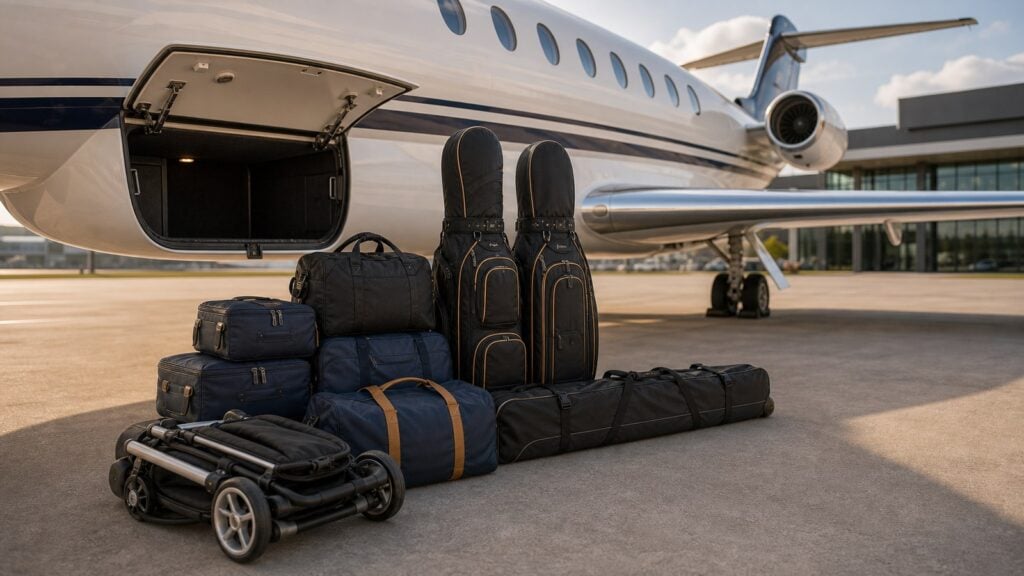
What Actually Fits On A Private Jet? Golf Clubs, Skis, Strollers, And Oversized Bags Explained
Private jet baggage is not only a cubic-feet question. Learn how aircraft tail, baggage-door size, hold shape, payload, runway conditions, and gear dimensions decide what actually fits.
Why this matters
TimeMake faster private aviation decisions without wading through fluff.
ControlGet clearer frameworks around pricing, timing, routing, and aircraft choice.
Peace of MindReduce friction for business travel, family logistics, and last-minute schedule shifts.
Table of Contents
- 1. Why Cubic Feet Alone Misleads
- 2. Aircraft Class Is Only The First Filter
- 3. The Five Variables That Decide Fit
- 4. Golf Clubs And Skis Need Their Own Conversation
- 5. Strollers, Car Seats, And Family Gear
- 6. Hard-Shell Suitcases Versus Soft Bags
- 7. How Baggage Can Change A Quote
- 8. Pre-Quote Baggage Checklist
- 9. Questions To Ask Before You Approve
- 10. FAQ
- 11. Can golf clubs fit on a light jet?
- 12. Can skis fit on a private jet?
- 13. Do soft bags really fit better than hard-shell luggage?
- 14. Can baggage change my private jet quote?
The short answer: a private jet can often take more unusual baggage than an airline cabin, but the real limit is not the marketing phrase “generous baggage space.” What actually fits depends on the exact aircraft, the cargo-door opening, the shape of the hold, whether the baggage area is accessible in flight, and the day-of-flight payload and runway plan.
That is why two jets in the same broad class can behave very differently. One light jet may handle a golf weekend cleanly with soft covers and compact bags. Another aircraft with a similar seat count may struggle with a full-size stroller, hard golf case, ski roller, and six rigid suitcases.
JetMaster rule of thumb: published baggage volume is only the starting point. Final acceptance depends on the exact tail, baggage dimensions, hold geometry, and the day-of-flight payload and performance envelope.

Why Cubic Feet Alone Misleads
Search results usually reduce private jet baggage to a cubic-feet number. That number is useful for orientation, but it is not a packing guarantee. A hold can advertise solid volume and still fail a mission because the cargo door is narrow, the bay is tapered, the longest item cannot turn inside the compartment, or the aircraft needs more fuel than expected for the route.
This is especially important for private charter because a quote is built around a mission, not a seat. If the bags change, the mission can change. That may mean a different tail, a larger aircraft category, a fuel stop, or a request to send an item separately.
JetMaster Executive Briefing
Start The Free Course
Make Your Next Private Flight Decision With More Control
Get the free 10-day JetMaster course built for founders, CEOs, investors, and business owners who value time, cost clarity, family convenience, safety, and smarter private aviation decisions.
Aircraft Class Is Only The First Filter
Aircraft class names are helpful, but they are not fully standardized across the market. A platform may call one aircraft light while another broker describes a nearby aircraft as strong-light or midsize. The better question is not “is it light or midsize?” It is “what exact tail is being quoted, and what does that tail allow on this route?”
| Planning case | Typical baggage reality | What to confirm |
|---|---|---|
| Very light jet | Best for compact luggage and short trips. One awkward item can drive the whole aircraft decision. | Cargo-door size, soft-bag preference, longest item, and whether the mission remains nonstop. |
| Light / strong-light jet | Can work well for small golf, ski, or family profiles when the gear is modest and soft-sided. | Golf or ski dimensions, stroller type, baggage access in flight, and total payload. |
| Midsize jet | More forgiving for normal suitcases, golf bags, skis, and family gear, but still not unlimited. | Actual hold shape, door aperture, passenger count, route length, and airport performance. |
| Super-midsize jet | Often the anxiety-drop category for mixed family, sports, and business baggage. | Whether baggage is accessible in flight, parking/airport constraints, and weight limits. |
| Heavy / long-range jet | Least likely to fail on simple volume. Issues are more often unusual shapes, mission economics, or route-specific rules. | Special cargo, hazardous items, customs, and whether large items need separate handling. |

The Five Variables That Decide Fit
A good broker or operator does not stop at “how many bags?” They should move through five variables before treating the baggage answer as reliable.
- Exact aircraft tail: model-level averages are useful, but the quoted aircraft and its configuration matter most.
- Cargo-door aperture: a long or rigid item can fail at the door even when the published volume looks large.
- Usable compartment shape: tapered spaces, internal structure, and bag stacking can reduce practical capacity.
- Access in flight: some baggage areas are external only, while others are accessible during the flight.
- Payload and runway envelope: passengers, bags, fuel, temperature, runway length, and altitude all interact.
Golf Clubs And Skis Need Their Own Conversation
Golf and ski trips are where baggage planning becomes visible fast. Soft golf travel covers are usually easier to accommodate than rigid hard cases because they bend around other bags and curved holds. Hard cases protect equipment, but they pack less efficiently and can become the one item that forces a larger aircraft.
Skis create a different problem: length. A standard ski bag, a padded two-pair bag, and a large rolling ski case are not the same operationally. Once the longest item moves toward 200 cm or more, the broker should verify the exact compartment and door rather than assuming the aircraft category can handle it.

Strollers, Car Seats, And Family Gear
For families, the word “stroller” is too vague. A compact travel stroller may be simple. A full-size stroller with bassinet, seat attachment, rain cover, diaper backpack, car-seat base, and extra carry-ons is a different baggage profile. The same is true for car seats: one question is whether the seat travels as baggage; another is whether the family wants to use an approved child restraint in flight.
Families should send the real list before aircraft selection. Include the number of checked bags, carry-ons, stroller type, car seats, travel crib, sports gear, pets, and anything that must remain reachable in flight. That is not overkill. It prevents the wrong aircraft from looking right on paper.

Hard-Shell Suitcases Versus Soft Bags
Hard-shell luggage is tidy and protective, but it can waste space in smaller private jet holds because fixed corners do not conform to curves. Soft duffels and soft-sided garment bags often pack better, especially in very light and light aircraft. This does not mean every traveler must use duffels; it means rigid luggage should be disclosed honestly when the aircraft is small or the passenger count is high.
A useful quote-stage phrase is: “Here are the dimensions, photos, and approximate weights of every long or rigid item.” That single sentence helps the operator move from assumption to confirmation.
How Baggage Can Change A Quote
Baggage can move the number even when the route does not change. If the original aircraft cannot legally or practically carry the real passenger-and-bag profile, the quote may need a larger aircraft, a new tail, a fuel stop, or a different airport strategy. That connects directly to JetMaster’s guide on why private jet charter quotes move after the first estimate.
The FAA weight-and-balance principle is simple: in many aircraft, filling all seats, all baggage compartments, and all fuel tanks at the same time may not remain inside approved limits. In private charter language, the real question is not only “can it fit?” It is “can it fit, remain legal, preserve the planned range, and operate from these airports today?”

Pre-Quote Baggage Checklist
- Ask for the exact aircraft model and, when possible, the exact tail.
- Send photos, dimensions, and approximate weights for every unusual bag.
- Identify the longest item and the most rigid item.
- Separate soft golf covers from hard golf cases.
- Separate compact travel strollers from full-size or double strollers.
- Ask whether baggage is external only or accessible during flight.
- Ask whether the mission remains nonstop with the real passenger and baggage load.
- Ask whether hot weather, short runway, mountain airport, or weight restrictions affect the trip.
Questions To Ask Before You Approve
- What cargo-door dimensions apply to this exact aircraft?
- What are the usable internal dimensions of the hold?
- Is the baggage area accessible during flight?
- Are any baggage areas unpressurized or unsuitable for sensitive items?
- Will golf bags, ski bags, stroller, car seat, and hard cases fit exactly as listed?
- Could this baggage list force a fuel stop or aircraft upgrade?
- Can the operator confirm acceptance in writing before payment?
FAQ
Can golf clubs fit on a light jet?
Often yes, especially with soft travel covers and a modest passenger count, but it depends on the exact aircraft, bag dimensions, and other luggage. Do not rely on seat count alone.
Can skis fit on a private jet?
They often can, but long ski rollers and multi-pair padded bags need exact pre-clearance. The longest item matters more than the phrase “ski bag.”
Do soft bags really fit better than hard-shell luggage?
Usually, yes, on smaller jets. Soft bags conform to curved holds and other bags more easily than rigid shells.
Can baggage change my private jet quote?
Yes. If the real gear list changes aircraft fit, payload, range, or airport feasibility, the quote can change even when the city pair stays the same.
Source note: Operational wording in this guide is based on the uploaded JetMaster research brief plus public aviation planning principles from the FAA weight-and-balance handbook chapter and aircraft specification examples such as the Pilatus PC-24 technical data. Final baggage acceptance is always operator, aircraft, runway, weather, route, and day specific.